

Carlo Mollino’s Table for ‘Italy at Work’
A Gift of the Italian government to the Brooklyn Museum, 1954
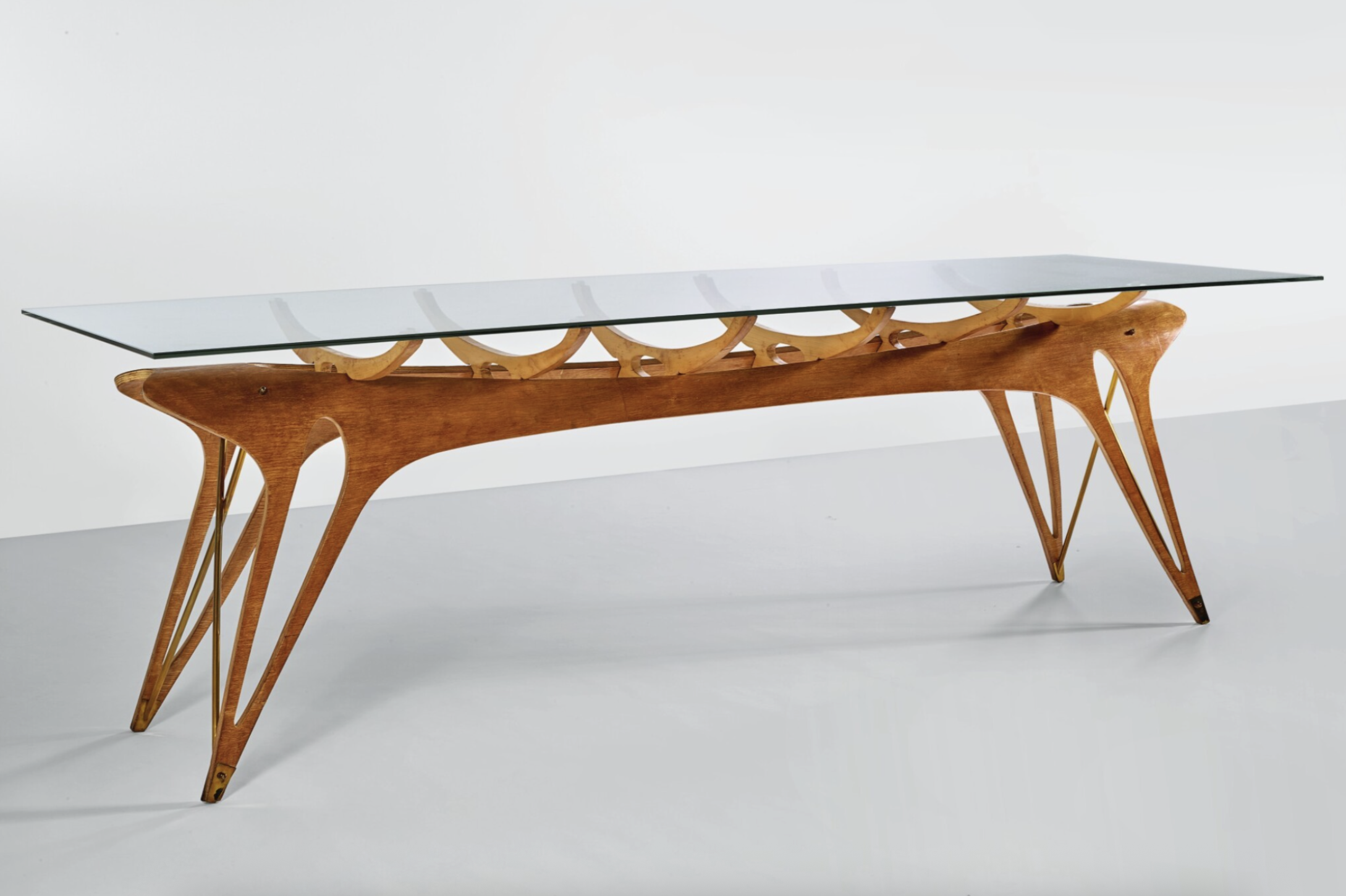
As part of the unique offering of important property deaccessioned by the Brooklyn Museum in 2020 through Sotheby’s, Louis Soulard worked on the research, documentation, and archives pertaining to this unique and important table by Italian architect, designer, and artist Carlo Mollino, in collaboration with leading experts and the Brooklyn Museum curatorial team. Sold for $6.2 million, doubling its high estimate, the sale was then seen as groundbreaking for a work of design.
The exhibition Italy at Work: Her Renaissance in Design Today, hosted first by the Brooklyn Museum in the fall of 1950 and which traveled to eleven major American museums thereafter, was an incredibly important and groundbreaking event. Its objective was to showcase and expose Italian art and design to an international audience in an effort to stimulate Italy’s economy following the end of World War II. As the country began to rebuild, the country saw an incredible surge in creative output from its artists and craftsmen. Among them was Carlo Mollino (1905-1973), who was an established architect as well as a Renaissance man—a daredevil—whose thrill-seeking approach to life, architecture, and design made him one of the most innovative and entirely original artists of the 20th Century. During this period, his discovery and embrace of molded plywood marked an important breakthrough in his design work. The present Dining Table, which was executed as a unique work by Mollino for Italy at Work, is a triumphant masterpiece by the artist, illustrating his artistic and technical daring and his entirely unique aesthetic. Characterized by sinuous lines, balanced forms and voids, and elegantly combined materials, this table embodies the anthropomorphic, animalistic, futuristic, and aerodynamic creations for which Mollino was best known. The first of only two large molded plywood dining tables created by the artist, the present lot represents an extraordinarily rare opportunity for collectors to acquire one of Mollino’s most unique and seminal masterpieces with exceptional provenance.
““Only when a work is not explainable other than in terms of itself can we say that we are in the presence of art. This ineffable quality is the hallmark of an authentic work.””
In 1945, World War II ended and Italy faced a new dawn unlike any it had seen before in its history. As a nation, conceiving a new government, rebuilding its battered cities, and recovering its economy would be an extraordinary task. As a people, however, Italy’s rich cultural history and traditions could not be dismantled even by the unprecedented destructiveness of the war years. The need to literally and physically rebuild the country—the birthplace of the Renaissance—called for Italian introspection and innovation. Observed by Meyric Rodgers, the then-Curator of Decorative and Industrial Arts at the Art Institute of Chicago, “the crisis brought into high relief that will to survival and constructive instinct that the Italian people have won through the long vicissitudes of their history”[1] and in the war’s wake “[emerged] again that stream of creative imagination—warm and rich in human values—which has inspired our civilization from its beginnings.”[2] The legacy of the Renaissance was at work in post-war Italy as the country began a new and revolutionary chapter in its long history as a leader of innovation.
Italy’s second artistic Renaissance was an essential element of the country’s broad reconstruction effort: the reinvigorated fields of art, design, and craft, which saw incredible growth and development during this period, would help to stimulate the economy as well as bring emotional healing to the population. Recognizing the need to rebuild as well as preserve and promote Italy’s artistic tradition of innovation, a number of philanthropic groups formed in Italy and the United States to support this progress, including the Compagnia Nazionale Artigianale (CNA), House of Italian Handicrafts, and Handicrafts Development, Inc. The concept for an exhibition came into view: Italy At Work: Her Renaissance in Design Today would showcase the breadth, richness, and ingenuity of contemporary Italian craft and expose it to the international marketplace.
The exhibition jurors, Charles Nagel (Director of the Brooklyn Museum), Meyric Rogers, Walter Dorwin Teague, and Ramy Alexander (Vice President of CNA), traveled across Italy seeking out the nation’s most talented artists, designers, and craftsmen. Their tour impressed upon the four American jurors the unbelievable scale of destruction from the war and, equally so, the surge of creative output from Italy’s artists and craftsmen who, out of necessity, adopted new production techniques and more accessible materials like brass, copper, and common woods. All mediums and genres would be represented in the exhibition, including furniture, jewelry, textiles, ceramics, glass, and metalwork, and nearly all of the 2,500 works selected were created in 1950. Anchoring the exhibition were five interiors—a foyer, a terrace, a private chapel, an all-purpose room, and a dining salon—each designed by a different artist.
By this time, Carlo Mollino (1905-1973) was an established architect whose unwavering individuality and lust for pushing the boundaries of art and design were reaching new heights, placing him at the forefront of this second Italian Renaissance. Mollino was born, educated, built a thriving career, and led a colorful, exciting life in Italy’s northern city of Turin. There he nurtured a diverse and lively repertoire of hobbies and passions, including skiing, poetry, racecar driving, photography, and flying stunt planes. The intellectual and physical nature of his various interests converged in the work he became most famous for: as an architect and designer. In the 1930s and 1940s, Mollino’s designs were recognized for their modern and incomparable style, combining line and volume in ingenious ways, both technically and aesthetically. Human anatomy was often reflected in his designs, whether in the silhouette of a mountain chalet outstretched like a craning neck, the interior of a theater enclosed in a ribcage-like structure, a chair’s backrest mirroring the curvature of the sitter’s spine, or the contours of a racecar recalling the feminine figure, making his creations deeply sensual and evocative. The ingenuity, excitement, and richness that suffused Mollino’s life and work qualified him as a “Renaissance man,” but he was distinguished most of all by his completely original vision and innovative spirit.
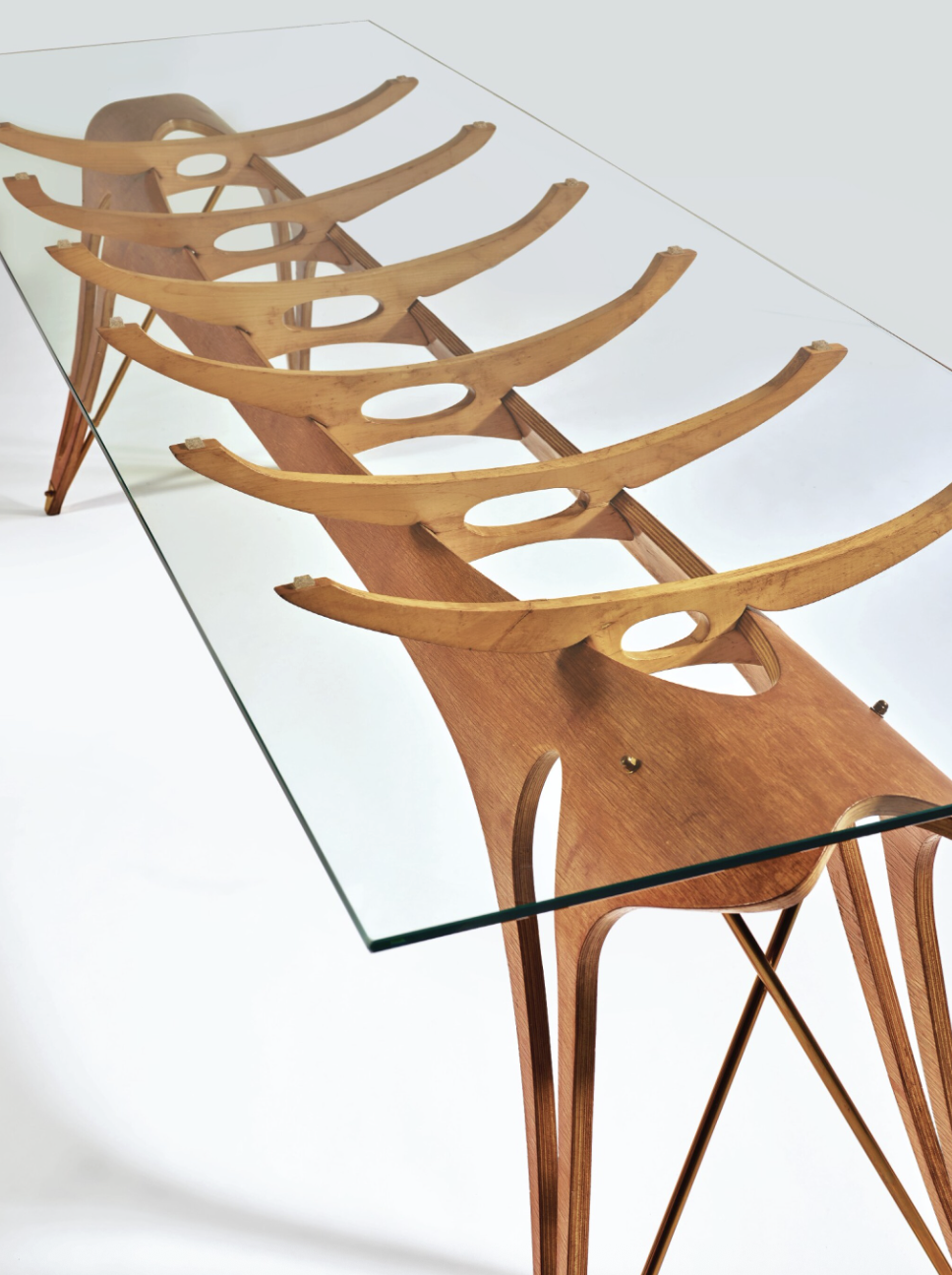
Enigmatic, anthropomorphic, and sensual, the Dining Table typifies the artist’s sophisticated ability to balance extravagant form with ultra-refined lines. The technique of bending and molding plywood, which Mollino developed in the late 1940s and was executed in the workshop of Appelli & Varesio in Turin, was complex yet versatile and yielded the sinuous lines and forms that became synonymous with Mollino’s œuvre. To mold plywood on such a large scale would have been an incredibly challenging and tenuous process, making the execution of this table a remarkable feat. The molded plywood structure is imposing yet delicate: defying nature, the tension of the bent wood imparts the work with incredible energy and dynamism. Its four-legged format promotes an animalistic quality as if the table might spontaneously animate. Six carved wood stretchers in meticulously crafted graduated scale surmount the molded plywood base, evoking vertebrae or ribs or even clavicles. It displays the same strength and frailty experienced by the human body, creating a mysterious sense of preserving the ephemeral. Equally impressive is the elegant incorporation of brass straps and a glass top, which tame this other-worldly form into its functional purpose. Its dynamism recalls both Art Nouveau and Futurism, but it’s modernity and ingenuity could only have been borne of Mollino’s unique vision and of the fertile creative period during which it was designed.
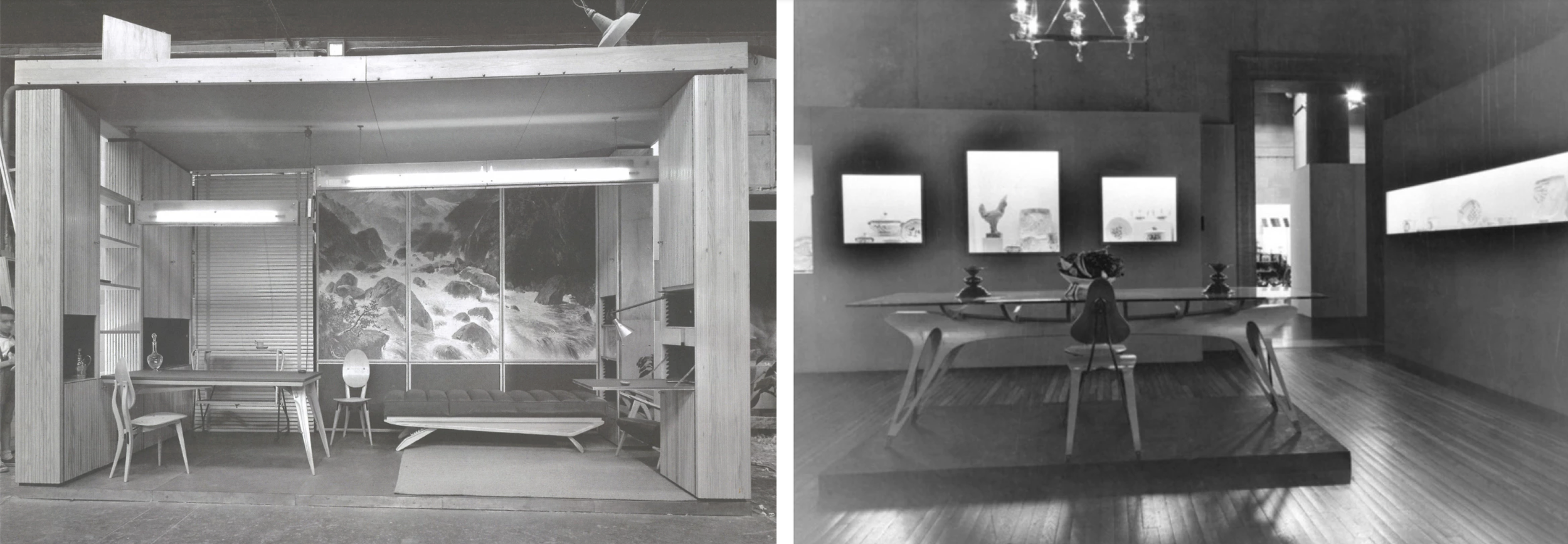
Mollino was commissioned to design the “All-Purpose Room (For Moderate Income)” for the Italy at Work exhibition. The space he created brilliantly integrated modular and mobile elements suited for contemporary Italian life, offering functionality, flexibility, comfort, and style. In addition to his interior, Mollino contributed to the exhibition two molded plywood tables, including the present Dining Table and a smaller coffee table, and a suite of six dining chairs. More than any of his other works on display in the exhibition, the Dining Table represented a revolutionary leap forward.
The conceptual singularity of the Dining Table upholds Mollino’s belief that “only when a work is not explainable other than in terms of itself can we say that we are in the presence of art.” However, it’s connection to the wider artistic landscape, both in Italy and beyond, also cannot be ignored. Meyric Rogers acknowledged this point observing that the Dining Table displays “a peculiarly Italian type of functionalism in which contemporary engineering devices are used with a sense of line and form which in spite of its daring has still an echo of tradition.”[3] Speaking on Italy’s reaction against “static post-impressionism,” Rogers described the country’s “emotional realization of the need to amplify the spatial concepts of the baroque.” He continued: “It attempted to express the dynamic interest of the times through the creation of form by continuous movement.”[4] We see this play out in the mystifying fantasy of the table’s form: its exuberance and vitality references the baroque, while its restrained lines, imaginative form and dimensionality, and ambitious approach to materials convey a distinctly post-war artistic philosophy.
Related themes were at work in the Concetti Spaziali (“Spatial Concepts”) of Mollino’s contemporary, the pioneering Italian artist Lucio Fontana (1899-1968) who, by slicing his canvases, sought to create a new type of art that was fully immersive. Fontana’s tagli (“cuts”)—not unlike the openwork of the structure of Mollino’s table—were the culmination of a series he began exploring in 1949, just a year before the Italy at Work exhibition. In Mollino’s Dining Table, we see echoes of Fontanta’s Spaitalism, a new type of art he founded for the post-war era based in science and technology that rejected representation and instead synthesized space, movement, color and sound into a singular art. With his Dining Table, Mollino achieved the mission of Spatialism to create art with infinite dimension.
The impulse to break with the traditional, the representational, and to challenge and push the potential of materials and of the art object itself was pervasive following the end of the war. The artist Piero Manzoni (1933-1963) pursued this new approach to art in his Achrome series of the late 1950s. By eliminating color, narrative, and his own aesthetic agency, he allowed the materials themselves to dictate the outcome of the artwork, unleashing the unlimited possibilities of an unimpeded surface. Stirrings of Manzoni’s expansive philosophy related to the infinitude of material seem to be reflected in Mollino’s use of molded plywood, which predated the Achrome series. Like Manzoni, Mollino challenged the physical limitations of his medium to expose its hidden potential without color, ornament, or overt references to the past to justify or elevate it.
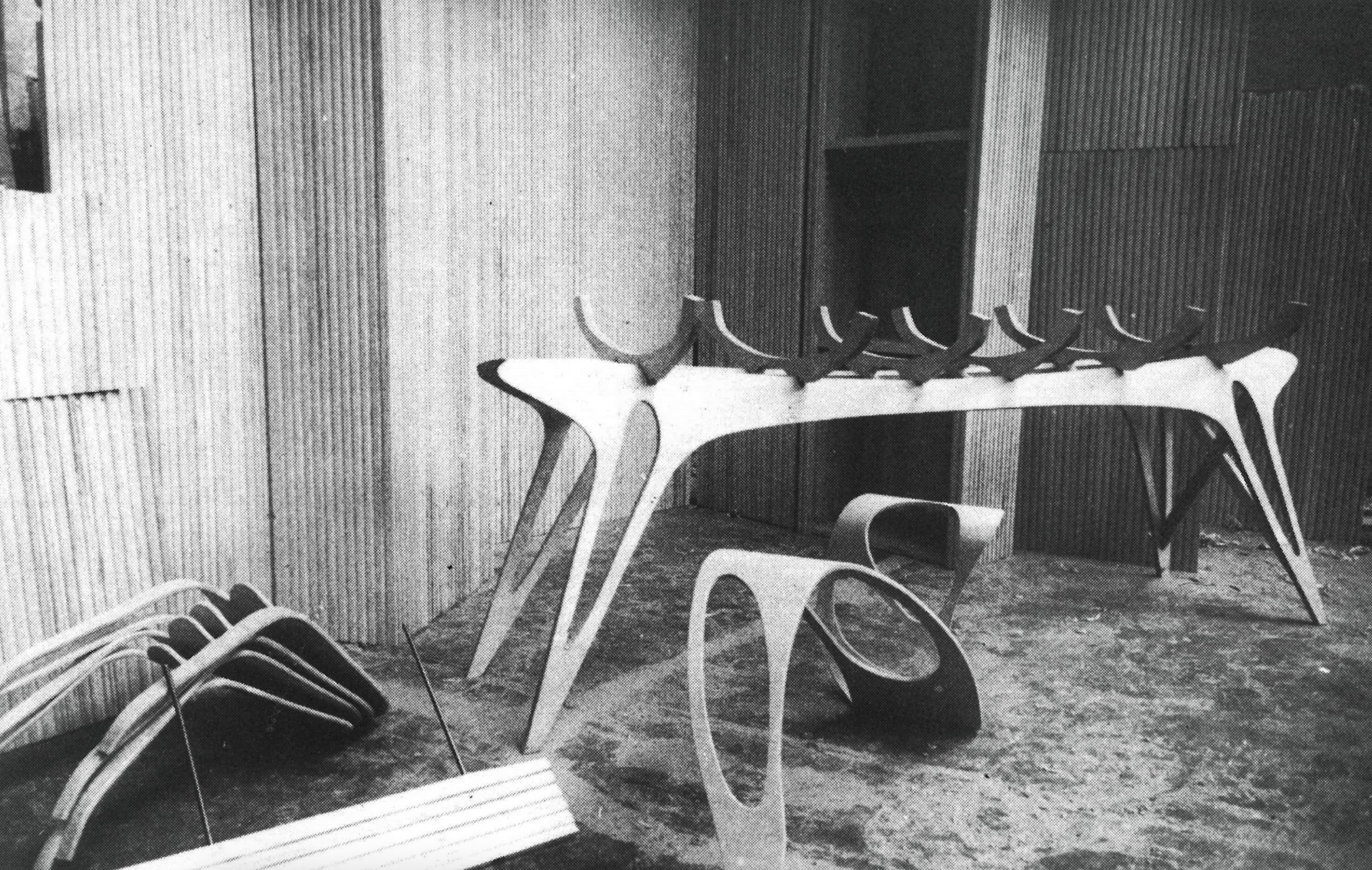
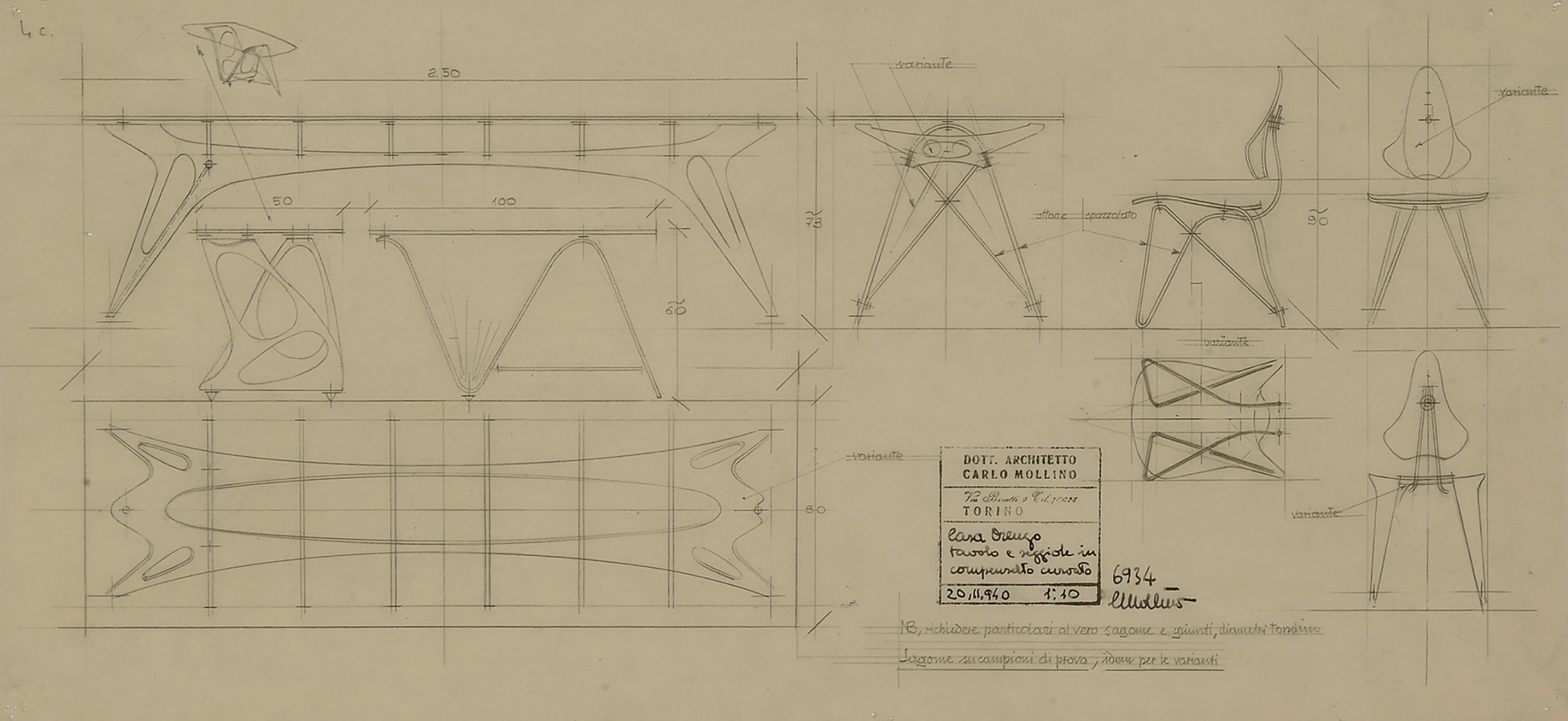
Mollino, whose design work was exclusively commission-based, originally conceived of the table for the interior scheme of Casa Orengo, but it was not executed for that purpose. The Italy at Work exhibition allowed him to realize this ambitious work without external expectations or limitations. Designing only for himself, satisfying only his own artistic urges and musings, the Dining Table marked an important turning point in his career. It was not only his first large-scale table in molded plywood, displaying a distinct departure from his earlier constructivist style, but it is the first of only two extant molded plywood dining tables by the artist (the other is held in a private collection, and a related molded plywood desk is held in the collection of the Centre Pompidou, Paris). The table represented what Mollino regarded as one of his most important and defining works. Though it exists solely on its own, entirely original and unique terms, the Dining Table speaks to an artistic movement that was concerned most of all with the future and with redefining the meaning of art in a new, unprecedented era. As a work of art and as a functional object, with this Dining Table Mollino testified to the innovation of Italian art and his own vision.
The Dining Table debuted at the premiere of Italy at Work at the Brooklyn Museum in 1950 and traveled with the exhibition to eleven other American museums. At the conclusion of the exhibition, it was gifted by the Italian government to the Brooklyn Museum, a gesture that demonstrated the atmosphere of friendship and collaboration between Italy and the United States, the Brooklyn Museum’s instrumental role in uplifting post-war Italian art and craft, as well as the significance of the work itself. It is one of Mollino’s most groundbreaking and important works ever to appear at auction, and the only work ever offered with such illustrious provenance and exhibition history.
Read more on sothebys.com