
A Unique Table by Jean Prouvé
One of several works by Jean Prouve in the colleciton of Tamotsu Yagi, a collection whose research and provenance work was supervised by Louis Soulard.
Jean Prouvé, who always held a keen interest in design that was accessible to all, dedicated the vast majority of his practice to developing forms that could be adapted and produced on a grand scale. Because of this interest in the prospect of mass-production, special commissions were uncommon – and especially so for unique objects made for individual private clients. The present lot stands as one such rare example, a unique illuminated table produced for a close friend of Prouvé, Dr. Gaston Vichard.
The Prouvé and Vichard family’s ties run all the way back to the 1880s, when Jean Prouvé’s father Victor studied at the École des Beaux-Arts in Nancy with the mother of Gaston Vichard, who would eventually become a close friend of Jean Prouvé. Vichard, upon becoming a doctor in the 1930s, became a significant patron of Prouvé’s work and lent financial support towards the development of Les Ateliers Jean Prouvé in Nancy, the first dedicated location of the Ateliers and the factory where Prouvé’s team would remain for nearly two decades.
Dr. Vichard moved to Vesoul, France in the early 1940s – a city that the doctor left a lasting influence on, and whose name has been immortalized in a street in the small commune – as he had been appointed to serve as a doctor there. After purchasing a house that was meant to serve as both the primary site of his medical practice and also a home for his family, Vichard immediately looked to Prouvé to construct a new veranda to overlook his garden, outfitted with furnishing including Prouvé’s “Visiteur” chairs.
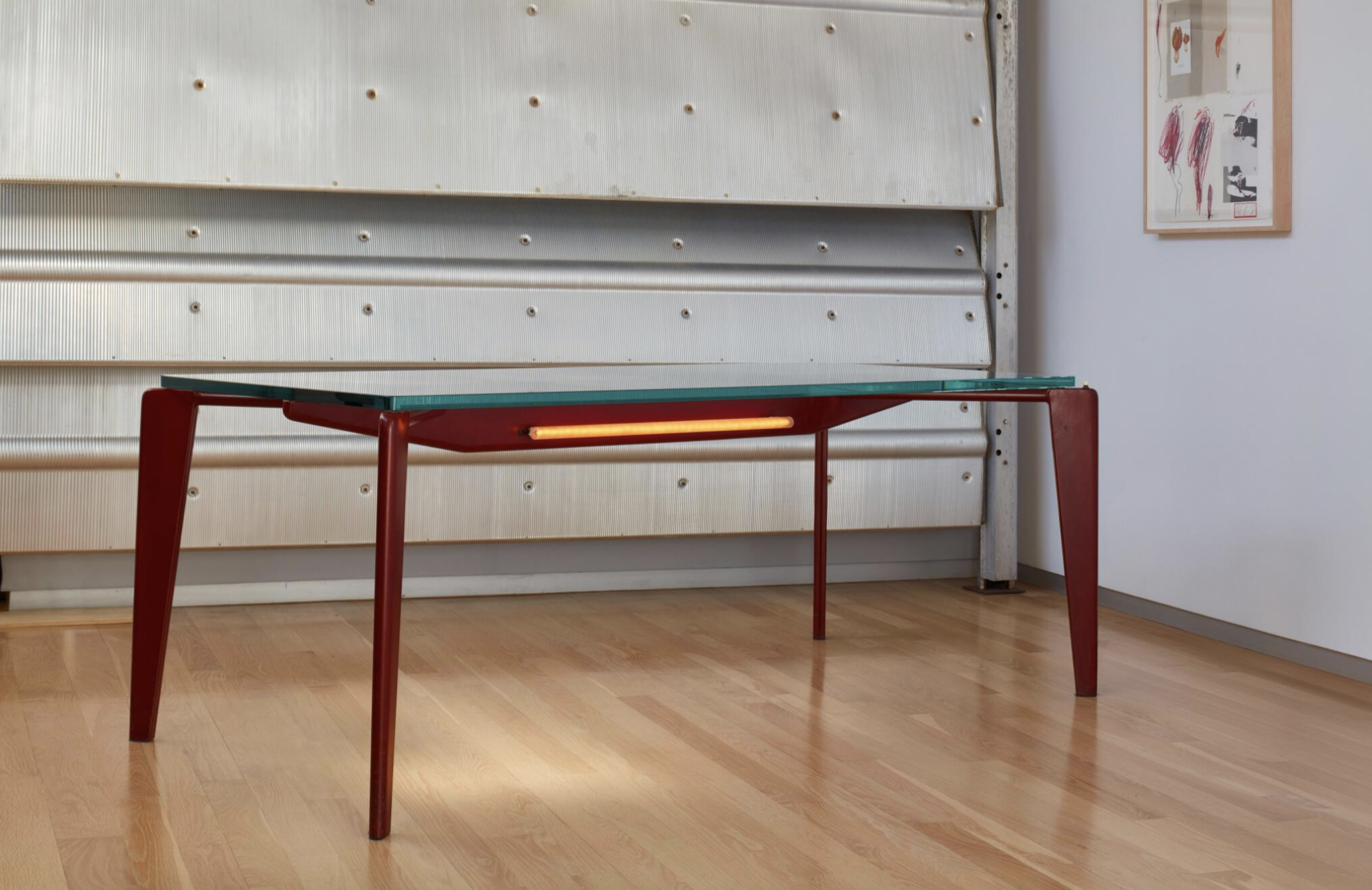
Vichard would commission pieces from Prouvé throughout their friendship, but the most significant of these was the present table – originally designed for the doctor’s home office, the table has been passed down through the decades by the Vichard family before eventually landing in the collection of Tamotsu Yagi, where it has served as one if its centerpieces for nearly 30 years. The table, featuring spider-like legs clad in red lacquer, expanded upon Prouvé’s earlier experiments in bent-steel table frames, chief among them the “Flavigny” table that was produced in 1942 for a sanatorium in Flavigny-sur-Ozerain, France, and the “S.A.M.” table from the same period.
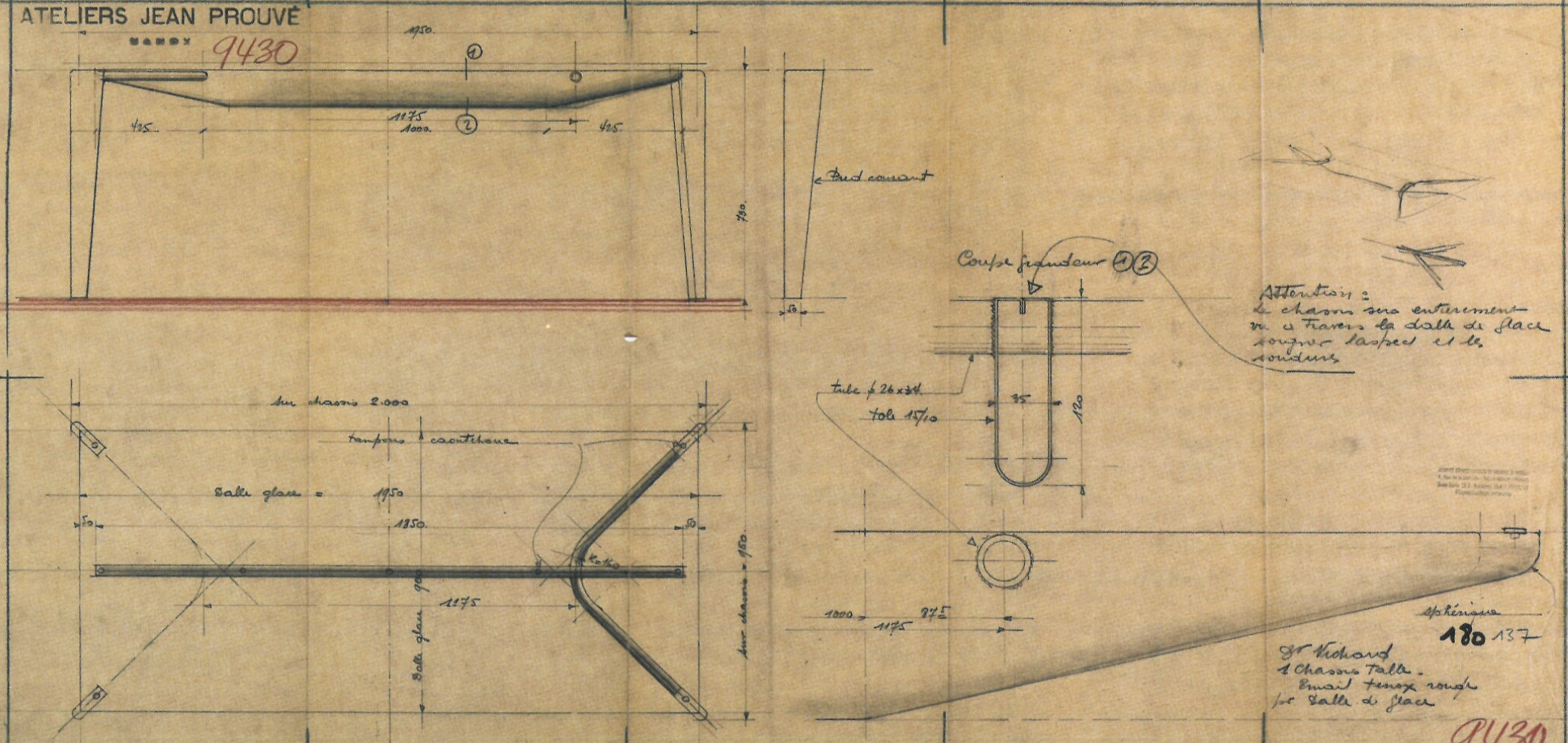
The base of the present table differed from the majority of his other similar designs in that its frame is designed to be bigger than the tabletop itself, resulting in legs that protrude from out under its top, their red lacquer becoming visible even from an above angle. Additionally, whereas other Flavigny-like tables feature a rectangular steel frame that a tabletop – typically made of stone or wood – could slot into, the unique table for Dr. Vichard features a central crosspiece of bent sheet metal that when combined with its diagonal legs, which taper gradually toward their base, allow the frame to hold the full weight of the heavier tabletop.
The table produced for Dr. Vichard is rendered even more unique for two exceptional features that were markedly different from all of Prouvé’s other similar tables, namely the inclusion of a thick glass tabletop and lighting strips affixed to each side of the table frame’s central crosspiece, including a button to activate the lighting component on a portion of one of the table’s protruding legs. These two additions complement one another remarkably, as the lighting strips illuminate the table from underneath the glass top, resulting in a diffused light that brightens not only the table itself but the space around it. The lighting component was devised by Prouvé specially for the doctor so that he could more easily look at radiographies in his office.
Read more on sothebys.com