

Noguchi’s Home
Sotheby’s New York, May 2019
A small sculpture by Isamu Noguchi offered in a May 2019 auction at Sotheby’s was an opportunity to revisit work conducted at the Noguchi Museum a few years prior— and specifically the relationship between Noguchi and Japan, here expressed through clay.
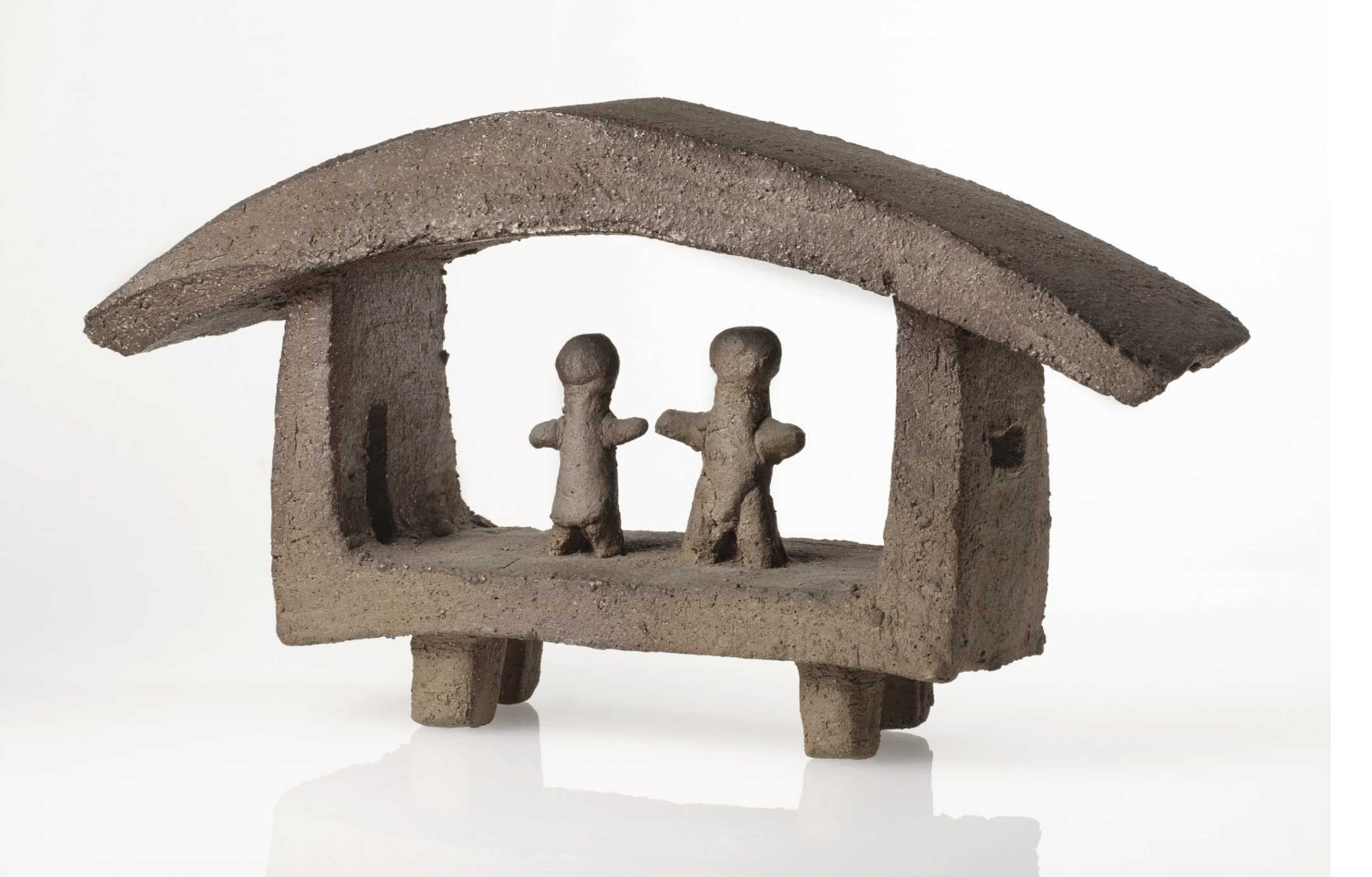
1952 was an enlightening year in Noguchi’s career, one in which he embraced Japanese visual culture and his own Japanese heritage in unprecedented ways. Facing a particularly tense and discriminatory post-war climate in the United States, Noguchi often travelled to Japan where he temporarily settled with his newlywed wife, Japanese actress Yoshiko Ōtaka. Starting in 1952, Noguchi rented the home and clay studio of famed potter Rosanjin Kitaoji, located in the small seaside city of Kamakura. There, he spoke Japanese, wore traditional kimonos, and brought to life his imaginary vision of an almost vanished Japan. Rosanjin’s studio allowed him to experiment with stoneware, thus resulting in the creation of abstract clay sculptures that combined ancient Japanese techniques with a Modernist sensibility.
Home, like many of his Kasama sculptures created in Kamakura, draws inspiration from ancient Japanese sculpture, specifically “Haniwa” terracotta figures and miniature homes, whose influences are especially visible here in the organic treatment of the figurative elements. Noguchi himself wrote: “My symbolism derived from the prehistoric roofs of “Haniwa,” like the protective abode of infancy, or even equating this with birth and death, the arch of peace with the dome of destruction.” Whether Home was intended as a depiction of his very own Japanese life at Kamakura with Yoshiko is unclear—though a similar sculpture titled Buson (1952), depicting the recluse Japanese poet of the same name and featuring a standing figure under a roof, certainly points in that direction. In any event, perhaps the best description of the ceramic work that he produced during that time can be found in this letter sent to his American friend Jeanne Reynal: “[…] it’s not just work, but work as a reflection of living”.