
Eileen Gray and Pierre Legrain masterpieces from the Perelman Collection

Much like Modern Masters in 2019, Louis Soulard oversaw the research, provenance, authentication, and catalogue production for the auction of Ronald O. Perelman’s design collection in December 2022.
The landmark auction featured a wide-ranging and comprehensive assemblage of one of the most significant collections of French Design to ever appear at auction. Featuring superlative examples of French Art Deco and modernist Design from the early 1920s through the 1940s, this curated body of work from the Perelman Collection tells the story of a quintessential period shaped by experimentation, innovation and a quest for modernity, highlighting the connections and intersecting trajectories uniting the key artists and patrons that shaped it. These pieces, brought together in this exceptional auction event, represent the highest standard of artistry, craftsmanship and provenance.
Meticulously assembled by their owner since the 1980s, this world-class collection features masterworks of Design not seen on the market in decades – including works by Eileen Gray, Pierre Legrain, Alberto and Diego Giacometti, Eugène Printz, Jean Dunand, Émile-Jacques Ruhlmann, Paul Dupré-Lafon, Jean-Michel Frank and Pierre Chareau, among others. Among the sale’s many highlights is an exceptional range of rare designs by Eileen Gray, including an important lacquered table from the artist’s personal residence, unique works by Pierre Legrain from the Jacques Doucet and Jeanne Tachard commissions, two magnificent sculptural sideboards by Eugène Printz, an extraordinary vanity table and mirror by Armand-Albert Rateau, important furniture and lighting by Alberto and Diego Giacometti, as well as comprehensive surveys of masterworks by Jean Dunand, Émile-Jacques Ruhlmann and Paul Dupré-Lafon.
The Tachard Villa at La Celle-Saint-Cloud:
A Legendary Commission
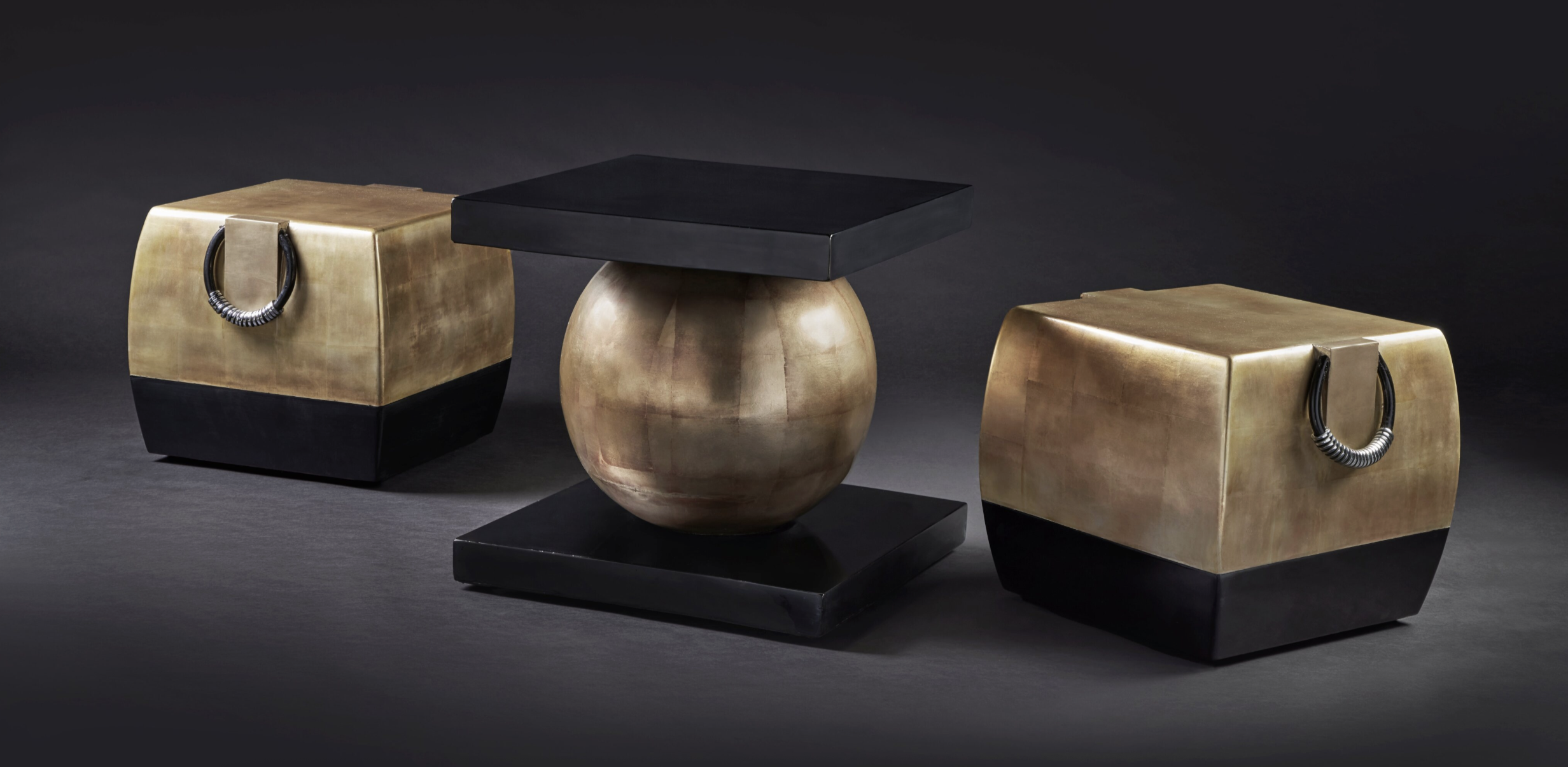
Commissioned by Ms. Jeanne Tachard for her villa at La Celle-Saint-Cloud, located on the outskirts of Paris, this pair of stools (lot 10) and side table (lot 11) constitute two of the most important furniture designs from this legendary project and further contributed to establish Legrain’s stature as a leader of the avant-garde. The two unique designs hold a particularly important place not only in the career of its maker but as masterpieces of 1920s European Art Deco.
The circumstances surrounding the creation of the present pieces can be credited in large part to none other than Jacques Doucet and attest to the word-of-mouth effect responsible for Legrain’s success. Much like Doucet, Jeanne Tachard was a prime figure in the Parisian fashion circles of the time. Née Poncin, she married André Tachard in 1901; six years later, they acquired the fashionable salon J. Suzanne Talbot, which quickly became highly successful in selling high-quality women’s hats in the years to follow and brought tremendous financial wealth to the couple. Tachard was known as an adventurous, free-spirited woman with a love of African art and the avant-garde. She developed a close bond with such artists as Foujita, Picabia and Lipchitz, as well as a unique approach to art and fashion which she shared with the equally daring Doucet—whom she supposedly advised in 1912 to get rid of his collection of classical art.
It is indeed Doucet who introduced Legrain to Tachard in the early 1920s. Intrigued by the couturier’s young protégé, Tachard initially hired Legrain to furnish the first floor of her Parisian apartment at 41 rue Emile-Menier, only to follow, in 1923, with the interior design for her country home at La Celle-Saint-Cloud. Legrain designed nearly everything in this serene secondary residence, from furniture and lighting to the architecture of the gardens, whose layout is reminiscent of Legrain’s bookbinding sketches. Discussing Legrain’s furniture and schemes for the villa at La Celle-Saint-Cloud in L’Amour de l’Art in 1924, critic Gaston Varenne observes: “… here Legrain has truly expressed the full measure of his talent” and recognizes Legrain’s ability to break with the past in his search for a vernacular of design, drawing a parallel with the Cubists’ search for a new formal language in painting.
Unlike the furniture made for Doucet, where eclecticism and exuberance took center stage, the Tachard commission comes across as more minimal and sober. Indeed, Legrain expressed himself very differently in his work for other clients. The two present lots embody a new, more mature phase in the oeuvre of the designer. Their respective, complementary design relies more heavily on a linear structure and clear geometric patterns reminiscent of Cubism and exhibit a rather radical proximity to the floor—also seen in a Japanese-inspired floor lantern and the lacquered seating occupying the main living area.
The pair of stools in particular (lot 10) can be seen as modern reinterpretations of the traditional East Asian drum stool, reinforced in the context in which the stools were displayed—beside a window in the dining room, in a grouping evocative of an ascetic Japanese interior. The decorative circular rings adorning two sides of the stools, on the other hand, arguably belong to African artistic traditions. There is an economy of tones and textures as well, punctuated by hints of color and occasional gold leaf accents, adding a level of luxury and sophistication to the bare forms. Black lacquer is used as a quiet yet silky counterpoint and grounds the base of the stools. The end result is an incredibly eclectic combination of artistic references that together form a delicately composed, elegant and well-proportioned design that is truly Legrain’s own.
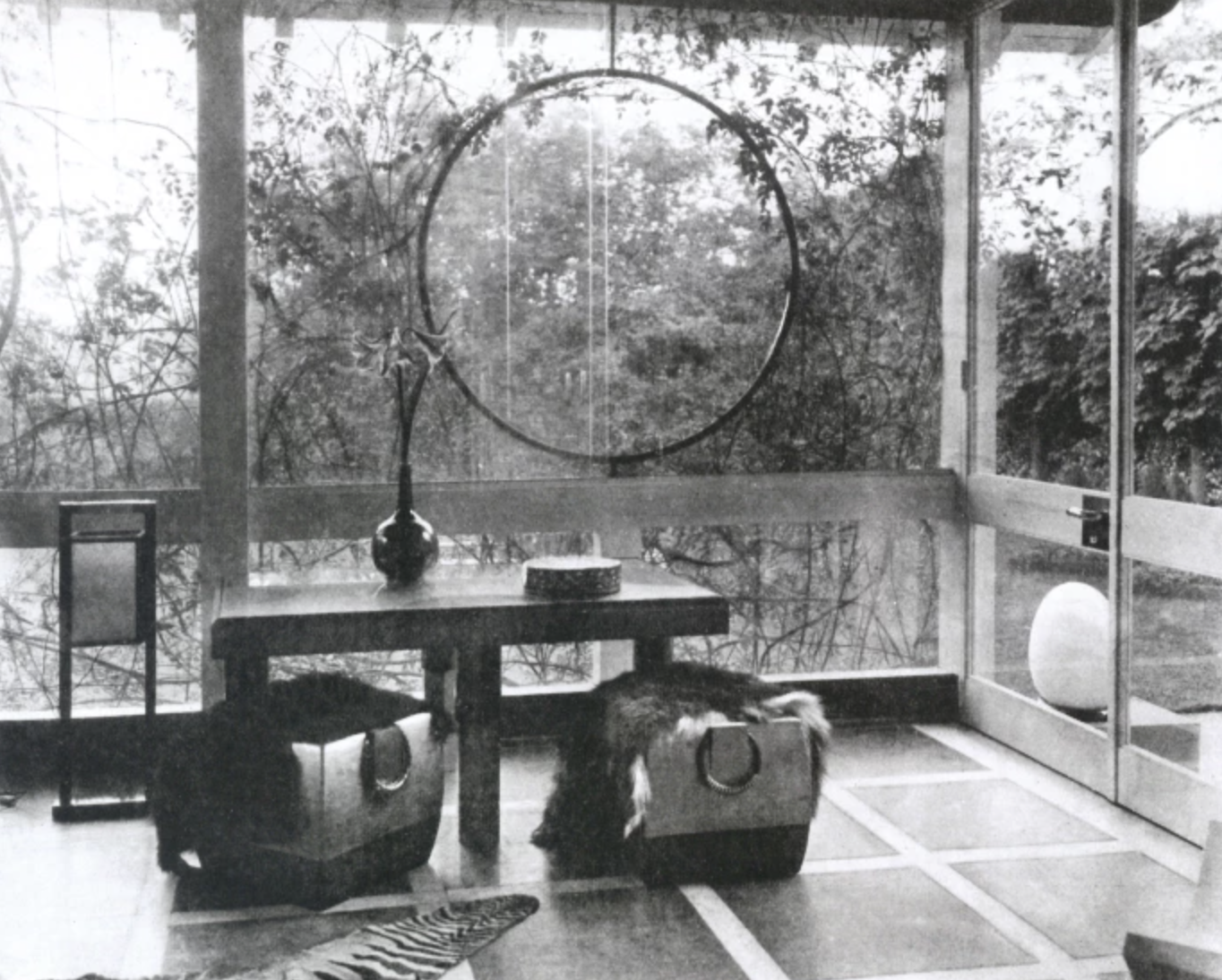
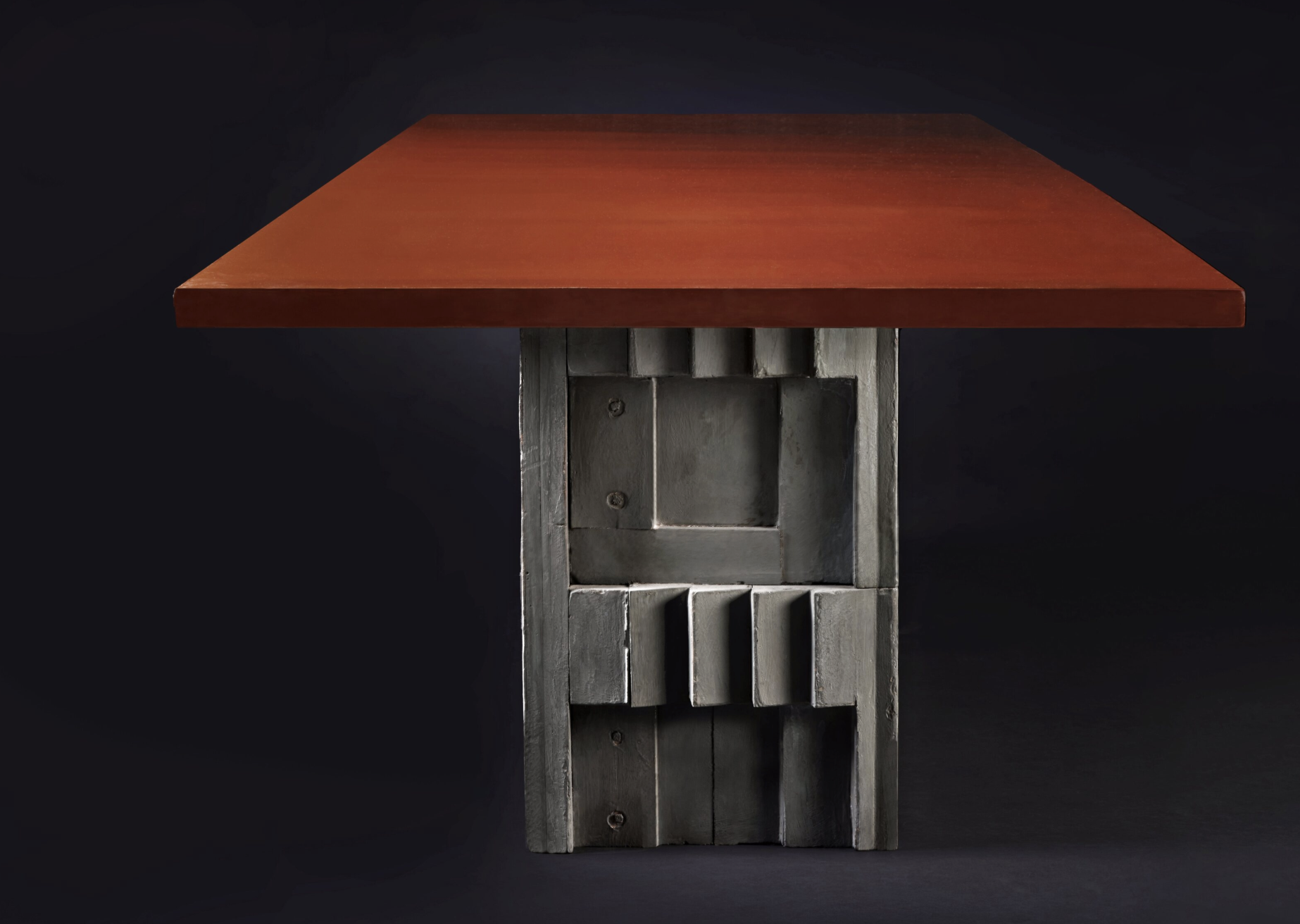
Equally as minimalistic in design, but no less powerful, the side table also presents with a highly geometric design—a perfectly executed wooden circle coated with gold leaf framed by two parallel horizontal surfaces in black lacquer. One can make the case that the table is more akin to a work of Cubist or Constructivist sculpture than a functional piece of furniture. As evidenced by archival photographs, the table occupied a rather central position in the main living room of the house—either placed as a standalone object in the middle of the room or flanking the room’s only lacquered armchair— and therefore played a key dramatic role in the composition of an otherwise deliberately spare interior.
Perhaps due to their visual similarities and shared technique, the two lots have evolved in tandem and shared the same prestigious owners for the following decades—Robert Walker, Robin Symes, DeLorenzo Gallery and finally Ronald O. Perelman—, hence attesting not only to the historical significance of the original commission but to the artistic vision that binds them together. The present side table and pair of stools are not only the stunning product of this important commission, they also attest to Legrain’s ability to push boundaries to create, quite beautifully, a new kind of functional objet d’art.
Pierre Legrain and Jacques Doucet:
Two Masters of the Avant-Garde
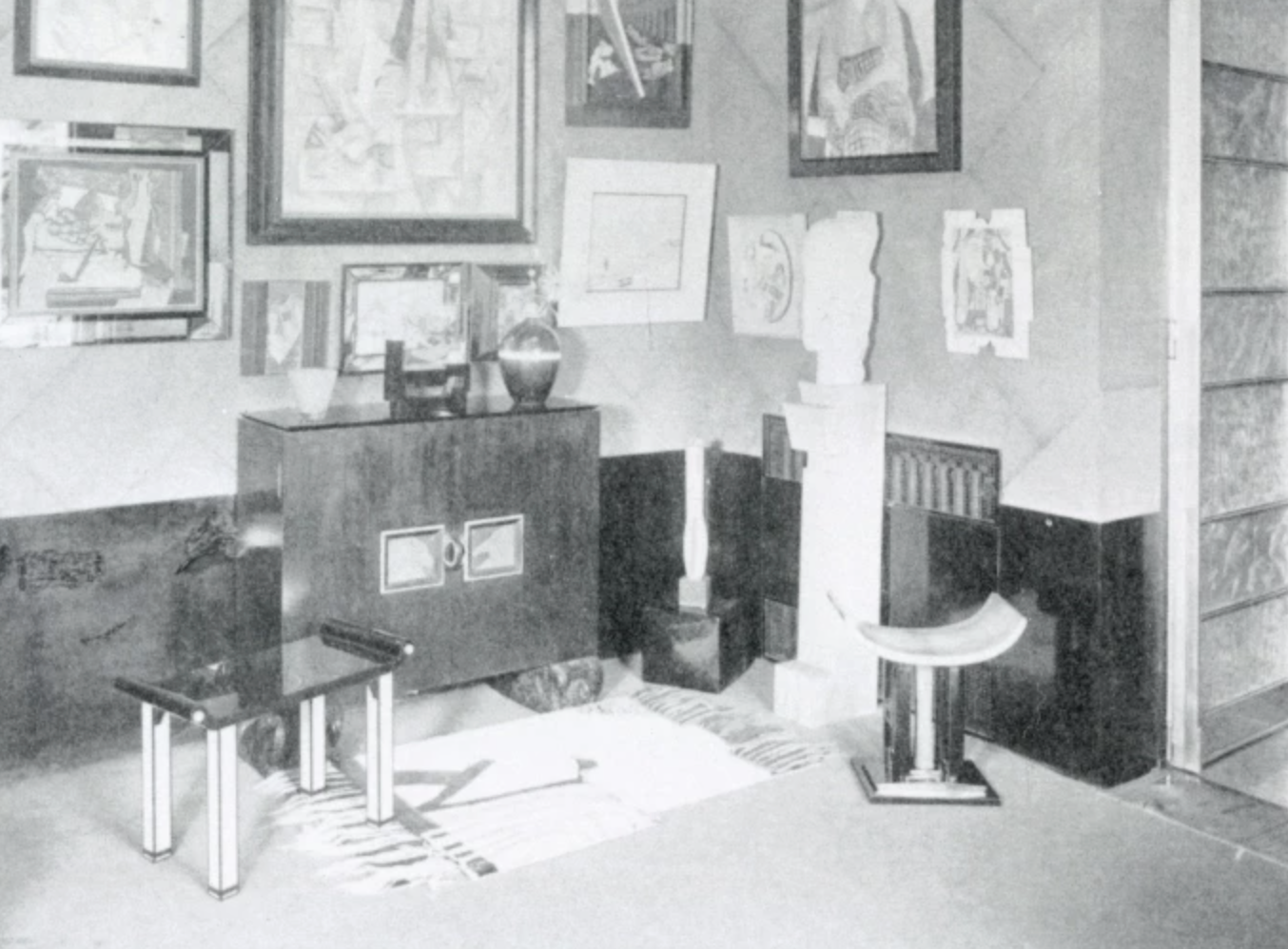
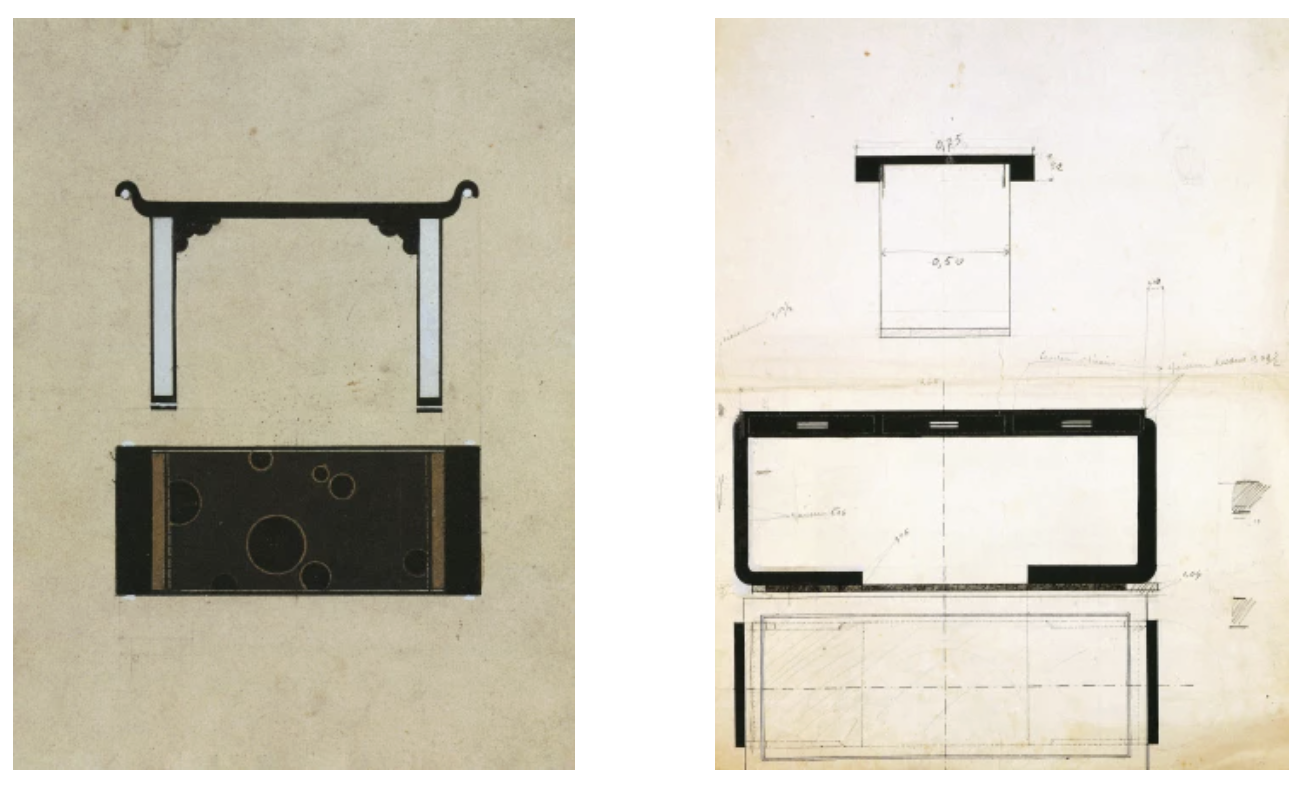
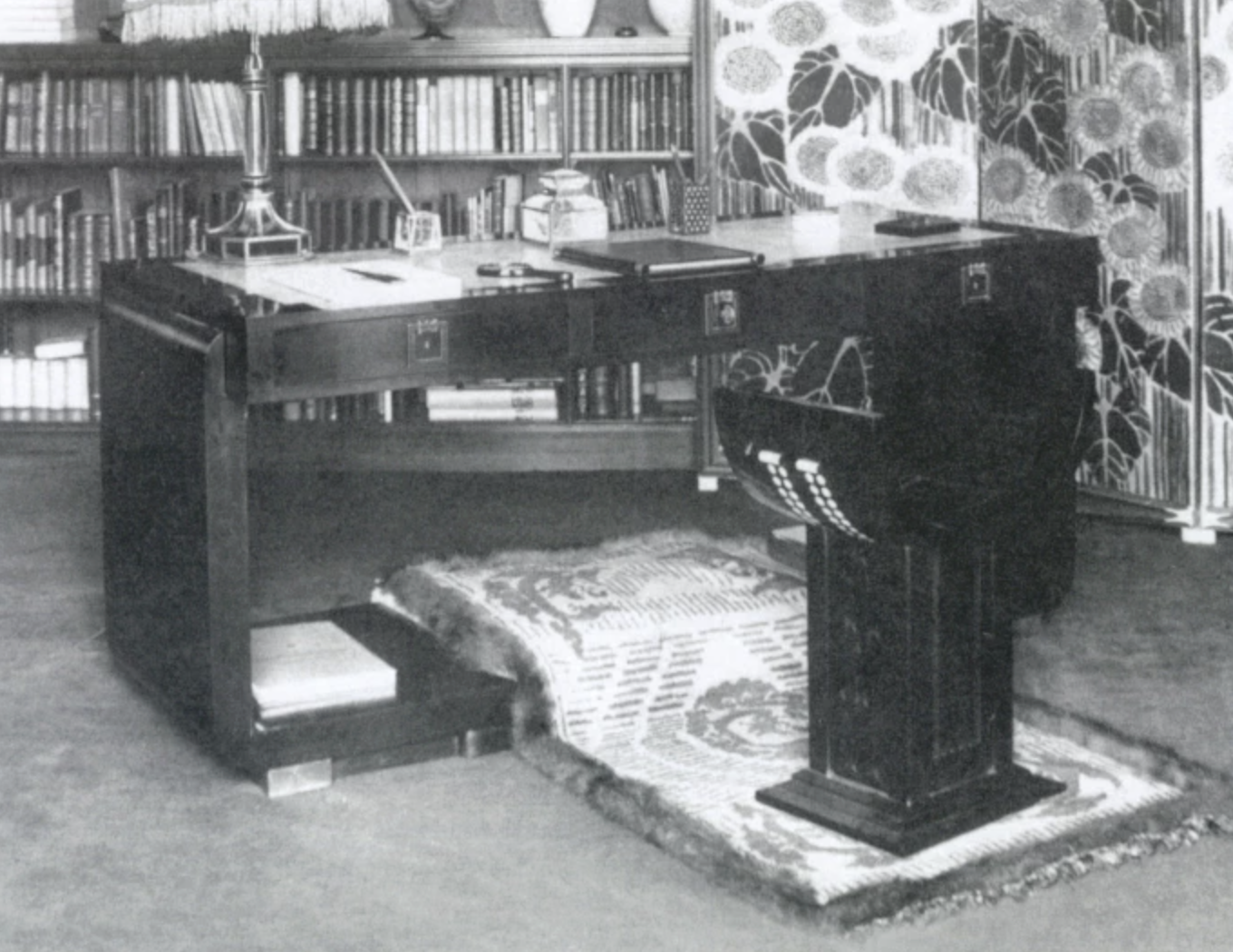
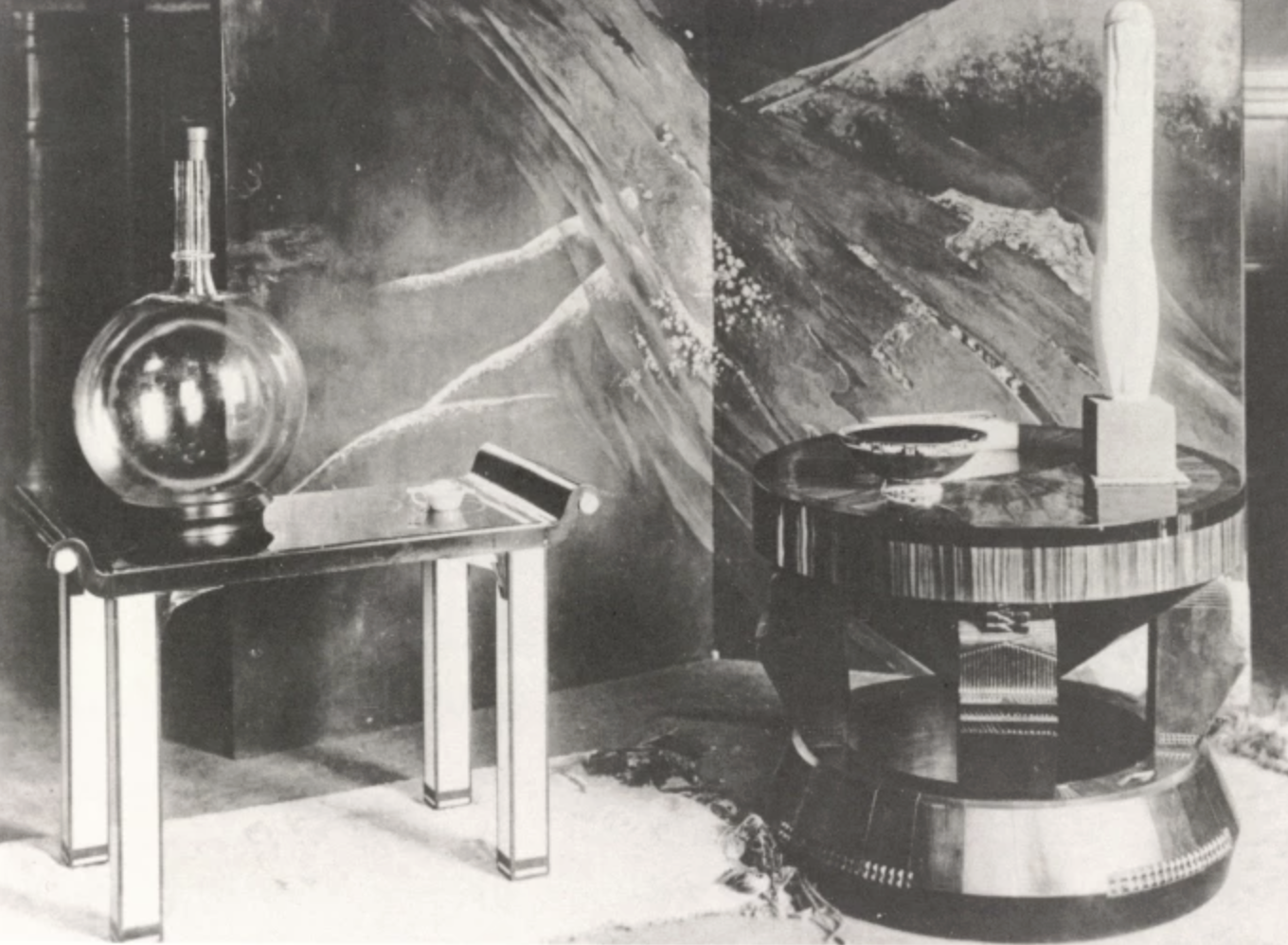
Few patrons may be as legendary and artistically significant in the history of 20th century design as Jacques Doucet. As Doucet’s designer and ensemblier of choice, Pierre Legrain created a small number of exceptional furniture pieces for him throughout the 1910s and 1920s, including the present desk (lot 22) and a tea table (lot 21). The masterpieces that comprised Doucet’s homes in Paris and Neuilly are now regarded by scholars and collectors alike as some of the most important and valuable works of pre-war European design. Sumptuous materials such as shagreen, ivory and lacquered woods gave life to Legrain’s highly experimental and modern forms that often reference African and East Asian visual cultures. They personified the exceptional and precocious talent of Legrain as an artist in his own right, whose work with Doucet shaped generations of avant-garde designers to come.
The chain of events that led to the present offering of exceptional pieces by Pierre Legrain (lots 21 through 23) might well be said to have been set in motion by another auction, a historic sale which took place in Paris in 1912. The sale in question was the dispersal of the extensive and highly important collection of French furniture, objects, sculptures, paintings and drawings from the eighteenth century assembled by the celebrated couturier Jacques Doucet. Already held in the highest esteem as a connoisseur and collector of rare discernment, Doucet made the bold decision to dismantle what had become, in his sumptuous hotel on the Rue Spontini, a remarkable museum dedicated to glories of the past, and to turn his attention to the present and future by collecting major avant-garde art and commissioning the most adventurous of contemporary design in furniture and furnishings.
His decision, a particularly challenging prospect for a man of nearly sixty, came at a time when the decorative arts in France were lacking the clear direction that had characterized the flourishing of the Art Nouveau style a decade earlier. In the early years of the twentieth century, the French were looking to foreign role-models, particularly the Wiener Werkstätte in Austria and the Munich Werkbund. Starting in 1913, Doucet enlisted designers Paul Iribe and Paul Poiret to create furniture and settings in a more contemporary vein for his Parisian home. Pierre Legrain worked with Iribe, and his evident sympathy with Doucet’s cultural eclecticism ultimately eclipsed Iribe’s more traditionalist approach. Surviving photographs and records of the Avenue du Bois interiors – some pictured here – confirm that Legrain’s preference for strong and inventive forms and minimal decorative detail were more in keeping with the dynamic, modern works to which Doucet was drawn, than the delicate lines and motifs of Iribe’s décor.
In 1917, Legrain accepted a contract from Doucet to create luxurious modern bindings for his book collection. Although this contract was terminated two years later, the close working relationship of patron and artist continued through the 1920s. In addition to a group of more than four hundred superb bindings, the legacy of their collaboration is a small number of remarkable furniture pieces that the designer created in response to Doucet’s aesthetic as early as 1919-1920. Their ultimate project, the installation of the Studio St. James in Neuilly, in conjunction with architect Paul Ruand, was initiated in 1926. Only a few photographs of the space survive, several of which were published in color in L’Illustration in 1930. They reveal a suite of rooms, meticulously, sumptuously and dramatically orchestrated as a setting for major works of art, perhaps most notably Picasso’s Les Demoiselles d’Avignon and Rousseau’s La Charmeuse de Serpents as well as works by Braque, de Chirico, Ernst, Matisse, Picabia and others. The apartment occupied the first floor. The entrance hall, stairs and upper lobby were lined in glass, a cool prelude to the riches beyond.
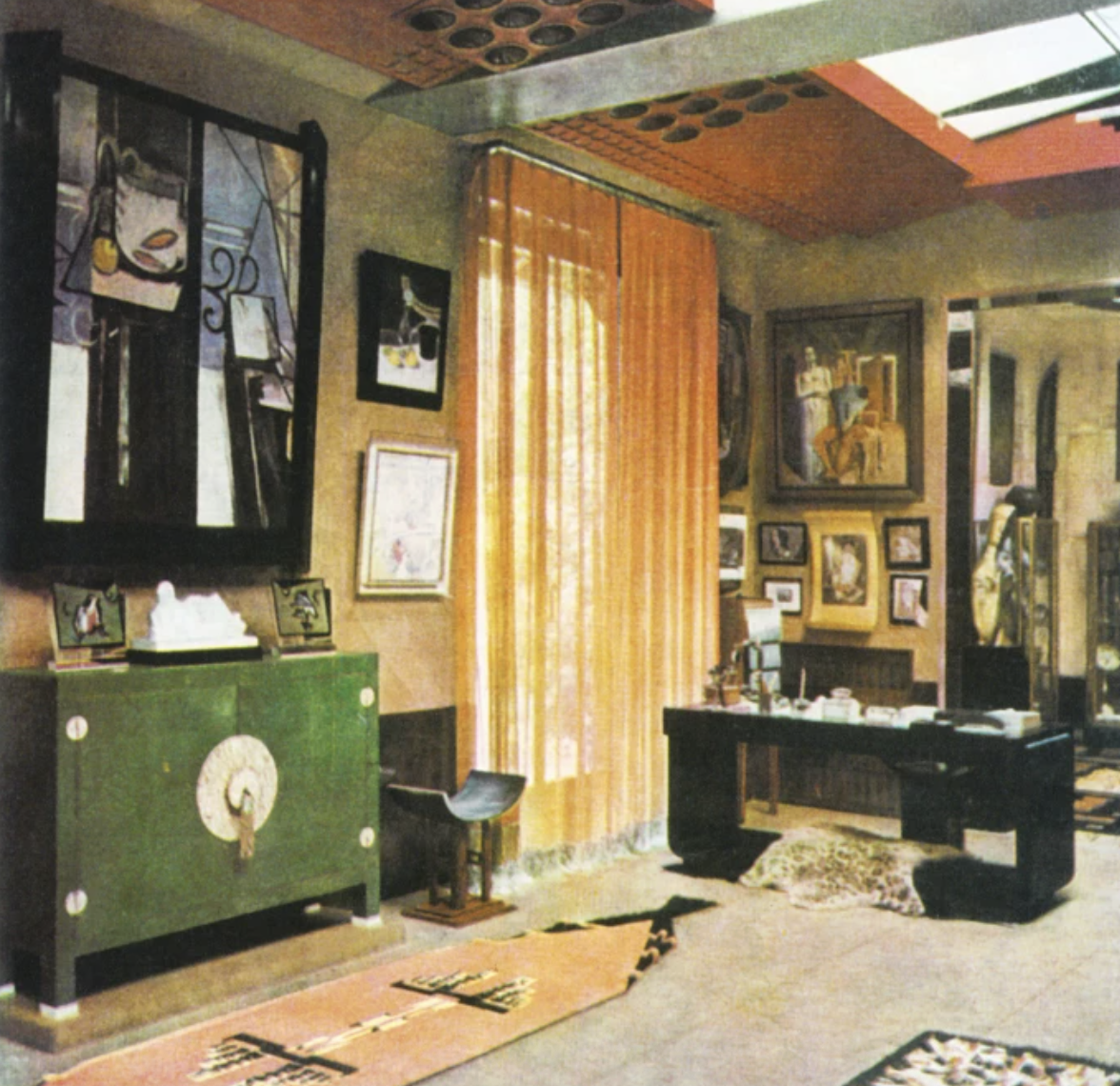
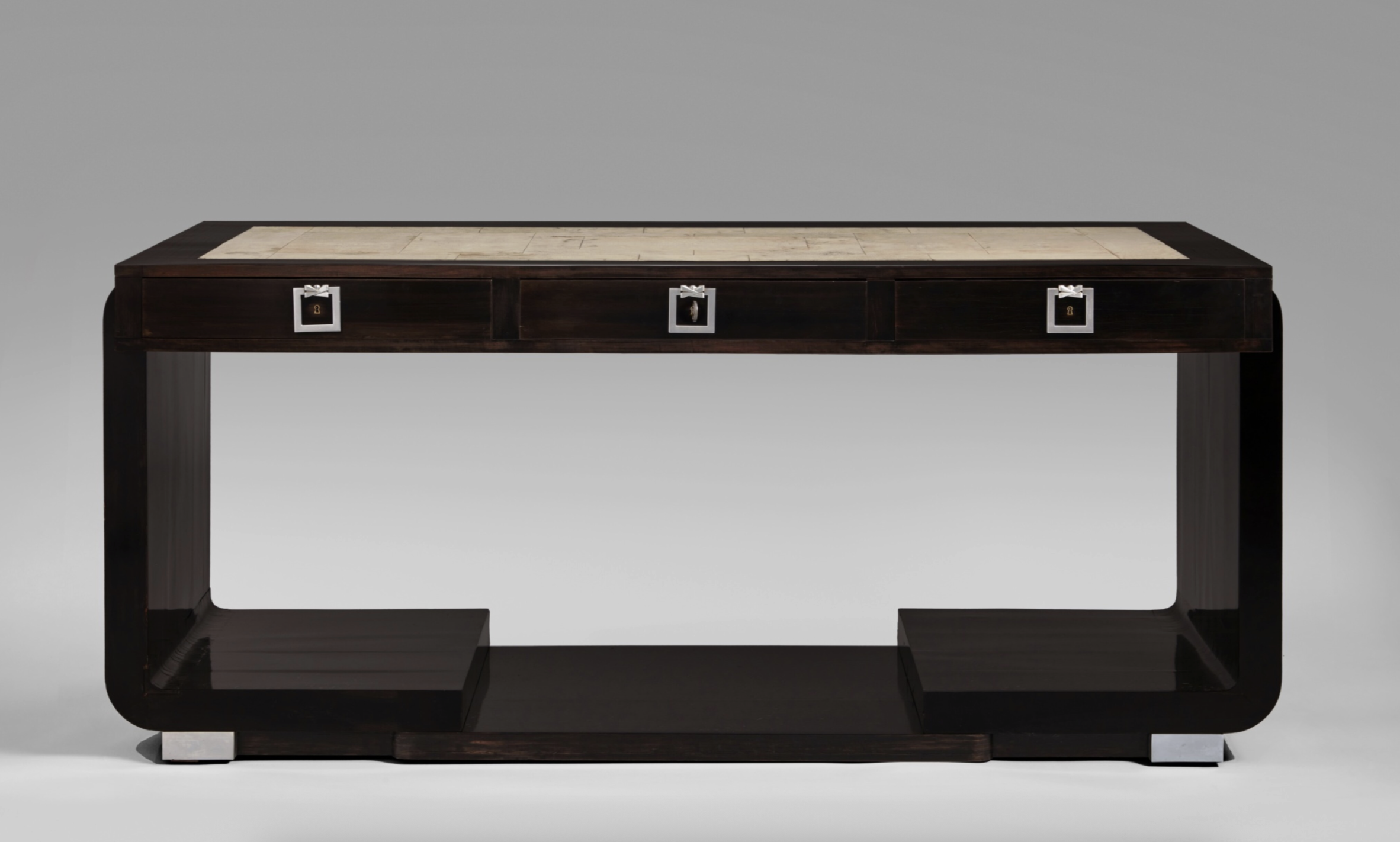
On the first floor, double doors by Lalique opened into the principal room, a salon-gallery where Legrain’s handsome ebony and shagreen desk (lot 22) beautifully divided this central area from the cabinet d’Orient beyond. L’Illustration’s photographs reveal that the desk was very much a functional piece of furniture used by Doucet, as evidenced by the various documents and objects dispersed on the desktop. Earlier documentation dating back to 1923 reveals that the present desk was already used in Doucet’s Avenue du Bois apartment and confirms an early 1920s production date. Its unusual form, which is longer and narrower than most desks from the period, complements stunning decorative details in the form of stylized silvered bronze keyhole frames. Preparatory drawings for the piece reveal that Legrain originally drew the three keyhole frames as more modernist in design –taking the form of two parallel horizontal lines–, possibly hinting at Doucet’s intervention in the creative process. Flawless in execution, the delicate combination of ebony, shagreen and silvered bronze complement a sleek design that personifies Doucet and Legrain’s symbiotic creative relationship throughout the 1920s. One of the exhibition booths at the Salon des Artistes Decorateur of 1923, curated by Pierre Chareau under the name Bureau-bibliothèque dans un appartement moderne, included the present desk together with other furniture pieces of Africanist and Modernist inspiration, which attracted critical acclaim.
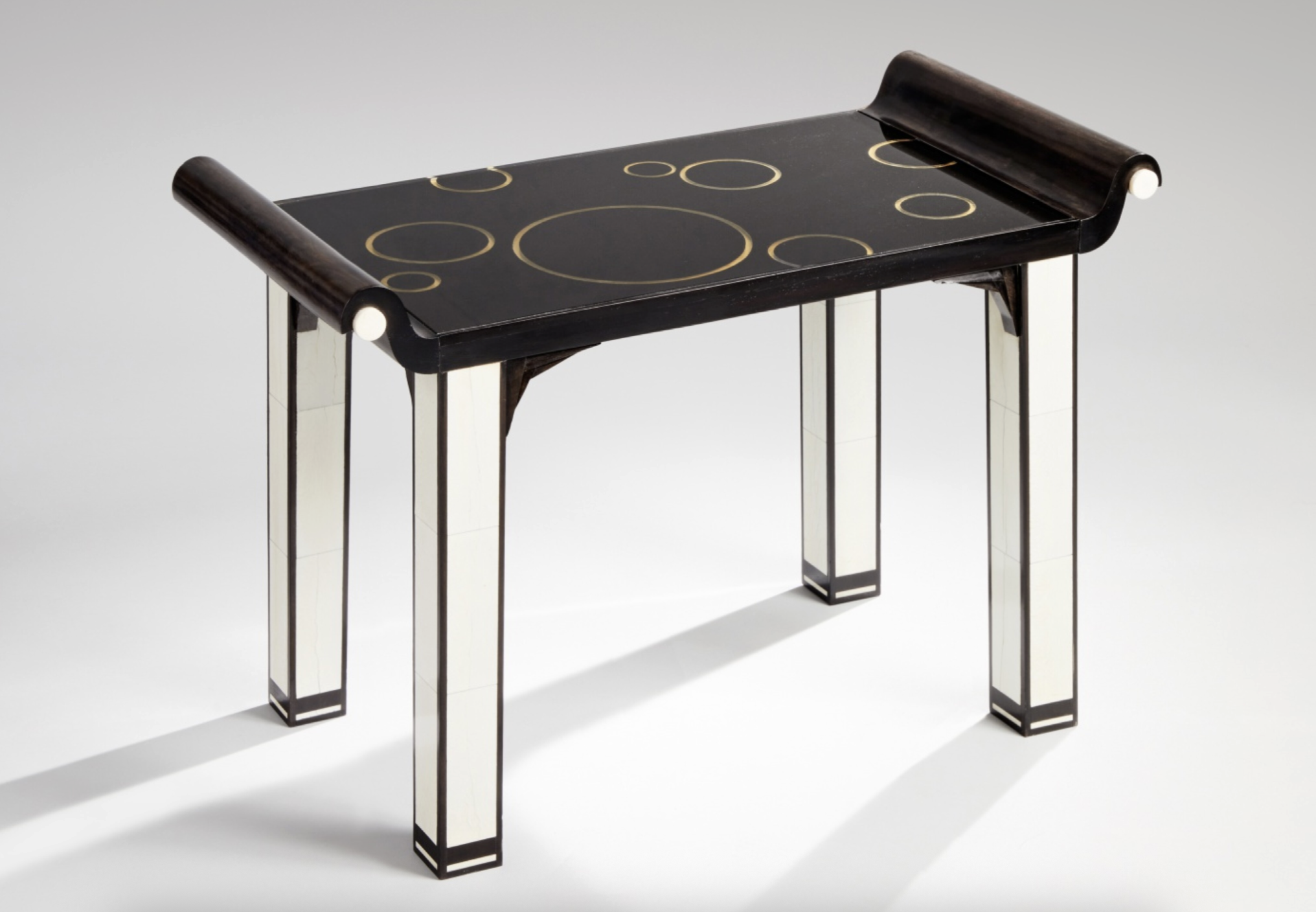
The precious ivory-paneled tea table (lot 21) also originates from Doucet’s Avenue du Bois residence and was likely made in the early 1920s. Photographs from 1925 indicate that the tea table was a central focal component of the apartment’s principal salon, placed alongside a large sofa by Marcel Coard, Paul Iribe’s “Nautile” sofa and Eileen Gray’s “Bilboquet” gueridon. When Doucet moved from Paris to Neuilly, the table was installed in the studio’s main “gallery,” where the preceding desk was also located, attesting to its artistic fluidity and versatile functionality. The table may represent Legrain’s boldest and most successful use of ivory, used here in rectangular panels to adorn the four legs of the piece. The swirling lines and arches that adorn the tabletop beautifully contrast with the linear base supporting it, while a removable glass plate with gold circular decorations further adds to the spherical visual leitmotif.
In the pieces created for Doucet, Legrain succeeded in distilling the cultural reference points and exciting sense of modernity evident in his patron’s collections of African, Japanese and avant-garde art. The Studio St. James was a highly personal cultural expression, embracing ancient and modern works— so-called “primitive” art and objects—as well as sophisticated contemporary elements in the pursuit of quality and authentic artistic expression. It has been suggested by scholar Raymond Foulk that “the main salon at Neuilly became one of the foremost and quintessentially representative selections of modern art to have been assembled at the time.”
Both Doucet and Legrain died in 1929 after the completion of the Studio St. James. The legacy of the furniture pieces from the Studio cannot be dissociated from their subsequent owners, earning them remarkable prestige and an immortal legacy over the following decades. While much of the furniture was subsequently acquired by the Musée des Arts Décoratifs in Paris, it was in the late 1960s that interest in the works of Pierre Legrain was rekindled amongst private collectors. A key figure in this process was Robert Walker, an American collector living in Paris. He learned of their work through period journals and began a painstaking process of locating these neglected masterpieces. His collection drew together many of the important works now offered in the present auction. The public consecration of these artists was achieved in November 1972 when an auction of furniture from the Doucet collection at the Hotel Drouot attracted international attention and set new records for 20th century design works; and again in 1989 with the sale of furniture from the New York townhouse of Robin Symes, inclusive of many of the present lots by Legrain and Gray from the Perelman collection.